
 SCHEDULE A SERVICE

Content:
- 1 When Do Air Ducts Need Replacement?
- 2 Key Takeaways
- 3 What Is Air Duct Installation?
- 4 When Is New Ductwork Needed?
- 5 Duct Repair vs. Duct Replacement
- 6 Partial vs. Complete Duct Replacement
- 7 Supply vs. Return Air Ducts
- 8 Flexible Ductwork vs. Sheet-Metal Ductwork
- 9 Why Does Correct Duct Sizing Matter?
- 10 Why Does Duct Layout Matter?
- 11 Why Should Air Ducts Be Sealed?
- 12 Do Air Ducts Need Insulation?
- 13 Can New Ductwork Improve HVAC Performance?
- 14 Can New Ductwork Improve Indoor Air Quality?
- 15 How Much Does Air Duct Installation Cost in Boerne?
- 16 Frequently Asked Questions
- 17 Choosing Air Duct Installation in Boerne, TX
A good HVAC system cannot perform properly if the ductwork is leaking, undersized, damaged, poorly routed, or missing adequate return airflow.
For homeowners considering air duct installation in Boerne, TX, the key question is usually not just whether new ducts are needed, but whether the problem can be repaired, partially replaced, or requires a larger redesign.
When Do Air Ducts Need Replacement?
Air ducts may need replacement when damage, leakage, incorrect sizing, poor layout, or deterioration affects a large portion of the system.
Possible signs include:
- Weak airflow from several vents
- Large temperature differences between rooms
- Crushed or collapsed ducts
- Disconnected sections
- Damaged insulation
- Widespread air leaks
- Excessive duct noise
- Poor return airflow
- Ductwork that does not match the HVAC equipment
An isolated leak or damaged branch may only require repair.
Key Takeaways
- Ductwork must include both supply and return airflow.
- Incorrect duct sizing can restrict airflow and increase HVAC strain.
- Leaky ducts can lose conditioned air into attics or other unconditioned spaces.
- Partial replacement may work when damage is localized.
- Full replacement may make more sense when sizing, leakage, or deterioration affects most of the system.
- Flexible and sheet-metal ducts serve different purposes.
- Air duct installation cost depends on duct length, materials, access, layout, insulation, and number of supply and return runs.
What Is Air Duct Installation?
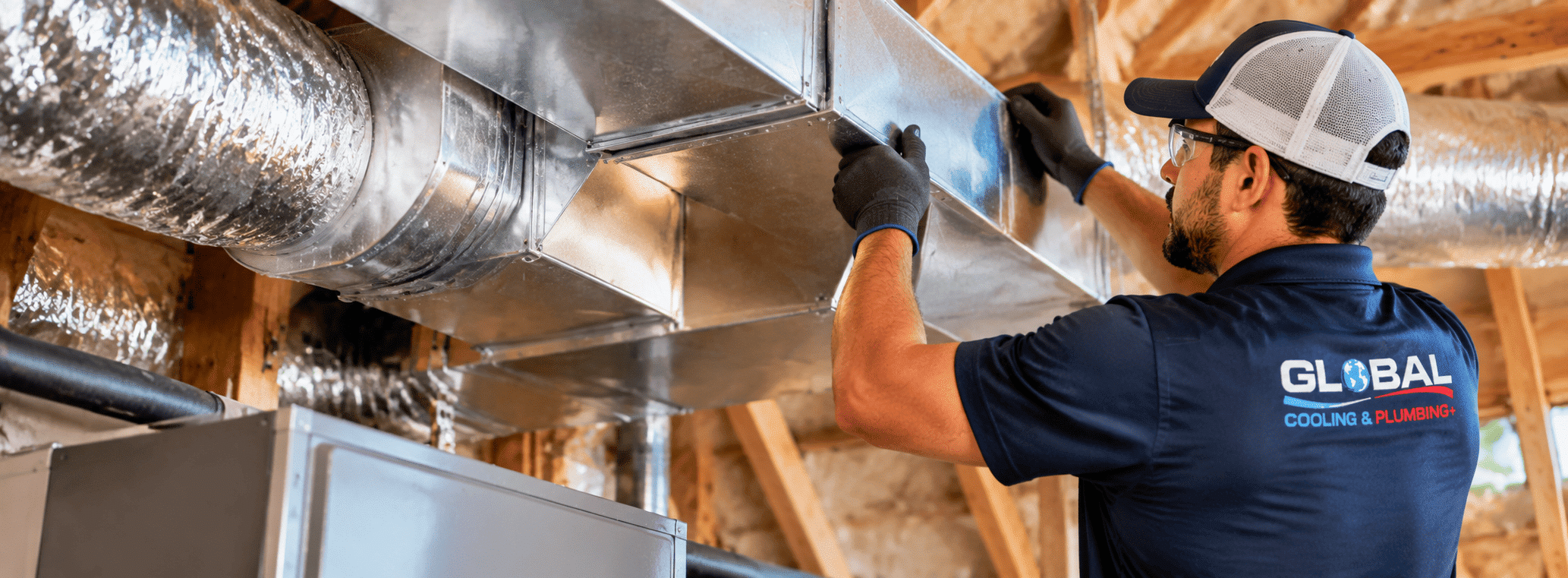
Air duct installation is the design and installation of supply and return pathways that move conditioned air between HVAC equipment and rooms throughout a property.
A duct system may include:
- Supply ducts
- Return ducts
- Trunk lines
- Branch ducts
- Flexible or rigid ductwork
- Registers
- Grilles
- Dampers
- Transitions
- Insulation
- Sealed joints
Supply ducts deliver heated or cooled air.
Return ducts carry indoor air back to the HVAC equipment.
Both are necessary for balanced airflow.
When Is New Ductwork Needed?
New ductwork may be needed for:
- New construction
- Central HVAC installation
- Home additions
- Garage conversions
- Finished attics
- Major remodeling
- Commercial buildouts
- Rooms with poor airflow
- New return-air pathways
- Replacement of damaged duct systems
The system should be designed around HVAC capacity, room needs, available space, duct length, and register locations.
Duct Repair vs. Duct Replacement
| Duct Problem | Repair May Work | Replacement May Make Sense |
| Small air leak | Yes | Usually not |
| One disconnected branch | Yes | If damaged |
| Minor insulation damage | Often | If widespread |
| Crushed flexible duct | Sometimes | Often if severe |
| Multiple damaged sections | Limited | Often |
| Incorrect sizing | Rarely | Often |
| Poor overall layout | Sometimes | Redesign may help |
| Major pest/moisture damage | Depends | May be needed |
The decision depends on condition, sizing, accessibility, and overall HVAC performance.
Partial vs. Complete Duct Replacement
Partial Replacement
Partial replacement may be appropriate when only one section is affected.
Examples include:
- One damaged branch
- One collapsed duct
- A disconnected run
- Localized moisture damage
- One room with airflow problems
- A damaged return duct
Complete Replacement
A larger replacement may be considered when there is:
- Widespread leakage
- Extensive deterioration
- Incorrect sizing throughout the property
- Multiple collapsed ducts
- Major insulation damage
- Poor overall airflow balance
- Ductwork incompatible with new HVAC equipment
Supply vs. Return Air Ducts
A balanced HVAC system needs both.
Supply Ducts
Supply ducts move heated or cooled air into rooms.
Sizing depends on:
- Room size
- HVAC capacity
- Duct length
- Register location
- Airflow demand
Return Ducts
Return ducts bring indoor air back to the HVAC equipment.
Insufficient return airflow may contribute to:
- Weak airflow
- Pressure imbalances
- Longer HVAC cycles
- Noisy grilles
- Uneven temperatures
Adding more supply vents without enough return airflow can create new problems.
Flexible Ductwork vs. Sheet-Metal Ductwork
| Feature | Flexible Duct | Sheet Metal |
| Structure | Flexible insulated material | Rigid metal |
| Common use | Branch runs | Trunk lines |
| Routing | Easier around obstacles | Requires fittings |
| Airflow | Can be restricted by sagging | More predictable |
| Durability | Easier to crush or tear | More resistant |
| Support | Requires proper tension | Requires rigid support |
Many systems use both.
Rigid ducts may be used for main trunks, while flexible ducts may serve individual rooms.
Why Does Correct Duct Sizing Matter?
Ducts that are too small can contribute to:
- Weak airflow
- High static pressure
- Whistling noises
- Long HVAC cycles
- Increased blower strain
- Uneven temperatures
Larger is not automatically better.
Duct size must match the HVAC system, airflow requirements, duct length, fittings, and room demand.
Why Does Duct Layout Matter?
Even correctly sized ducts can perform poorly when the layout is inefficient.
Common problems include:
- Long duct runs
- Sharp bends
- Compressed flexible ducts
- Sagging
- Excessive turns
- Restricted transitions
- Poor return placement
A more direct layout can reduce airflow resistance.
Why Should Air Ducts Be Sealed?
Duct leaks can waste conditioned air and affect indoor comfort.
Supply leaks may release cooled or heated air into:
- Attics
- Garages
- Crawl spaces
Return leaks may pull in:
- Dust
- Insulation fibers
- Humidity
- Unconditioned air
Proper sealing helps reduce unintended air loss.
Do Air Ducts Need Insulation?
Ducts located in unconditioned spaces generally require suitable insulation.
Insulation can help:
- Reduce heat gain
- Reduce heat loss
- Maintain supply-air temperature
- Limit condensation
- Support HVAC efficiency
Damaged or compressed insulation may need repair or replacement.
Can New Ductwork Improve HVAC Performance?
Yes, when poor ductwork is the cause of the problem.
New ductwork may help when it corrects:
- Major air leakage
- Incorrect sizing
- Poor routing
- Crushed ducts
- Inadequate return airflow
- Damaged insulation
However, duct replacement will not solve every comfort problem.
HVAC equipment condition, insulation, air sealing, windows, thermostat settings, and maintenance also affect performance.
Can New Ductwork Improve Indoor Air Quality?
Properly sealed ductwork may reduce contaminants entering through damaged return ducts.
Potential sources include:
- Dust
- Insulation fibers
- Humid air
- Pest debris
- Construction debris
Indoor air quality also depends on filtration, ventilation, humidity control, and indoor contaminant sources.
How Much Does Air Duct Installation Cost in Boerne?
Air duct installation cost in Boerne depends on the size and complexity of the duct system.
Important cost factors include:
- New installation vs. replacement
- Total duct length
- Number of supply runs
- Number of return ducts
- Flexible vs. metal ducts
- Attic or ceiling access
- Duct sizing
- Insulation
- Sealing
- Removal of old ducts
- Register and grille installation
- HVAC system size
- Airflow testing
Replacing one damaged branch generally requires less work than installing an entirely new duct system.
Frequently Asked Questions
What are the signs that air ducts need replacement?
Weak airflow, large room-to-room temperature differences, crushed ducts, widespread leaks, damaged insulation, excessive noise, and poor duct sizing may indicate replacement is needed.
Is replacing old ductwork worth it?
It may be worthwhile when the system has significant leakage, incorrect sizing, extensive deterioration, or poor airflow. Isolated problems may only need repair.
Can new ductwork improve airflow?
Yes. New ductwork may improve airflow when it corrects restrictions, leakage, crushed sections, poor sizing, or inadequate return pathways.
Can bad ductwork make rooms hotter or colder?
Yes. Improper duct sizing, leaks, restrictions, or poor layout can contribute to uneven temperatures between rooms.
What type of ductwork is best?
The best material depends on the application. Sheet metal is often used for trunk lines, while insulated flexible duct may be used for branch runs. Many HVAC systems use both.
Can I install HVAC ductwork myself?
Air duct installation requires proper sizing, layout, support, sealing, insulation, and HVAC integration. Poor installation can restrict airflow and reduce system performance.
Do air ducts need insulation?
Ducts in attics, garages, crawl spaces, and other unconditioned areas generally require suitable insulation.
Choosing Air Duct Installation in Boerne, TX
The most important question is whether the duct system can move the correct amount of air efficiently throughout the property.
A single damaged section may only need repair or partial replacement.
Widespread leakage, incorrect sizing, poor layout, or multiple deteriorated ducts may justify a larger replacement.
Global Cooling & Plumbing+ provides air duct installation, partial and complete duct replacement, duct sealing, insulation, supply and return ductwork, and airflow evaluations in Boerne.
Call Global Cooling & Plumbing+ at 830-992-7887 to schedule an air duct evaluation in Boerne, TX.