


Content:
- 1 What Is Indoor Air Quality?
- 2 Indoor Air Quality Solutions for Boerne Homes
- 3 Signs of Poor Indoor Air Quality
- 4 Common Indoor Air Quality Concerns in Boerne
- 5 Whole-Home Air Filtration
- 6 Media Air Cleaner Installation
- 7 Whole-Home Air Purifier Installation
- 8 UV Air Treatment Systems
- 9 Whole-Home Humidity Control
- 10 Air Duct Cleaning in Boerne
- 11 Air Duct Sealing
- 12 Ventilation Improvements
- 13 HVAC Maintenance and Indoor Air Quality
- 14 How Our Indoor Air Quality Process Works?
- 15 How Much Do Indoor Air Quality Services Cost in Boerne?
- 16 Air Filter vs. Air Purifier
- 17 Portable Air Purifier vs. Whole-Home Air Purifier
- 18 How Can You Check Indoor Air Quality?
- 19 What Is the Best Way to Improve Indoor Air Quality?
- 20 Why Choose Global Cooling & Plumbing+?
- 21 Schedule Indoor Air Quality Service in Boerne, TX
- 22 Frequently Asked Questions About Indoor Air Quality
- 22.1 What is indoor air quality?
- 22.2 What are the signs of poor indoor air quality?
- 22.3 What causes poor indoor air quality in Boerne homes?
- 22.4 How can I check the indoor air quality in my home?
- 22.5 What is the best way to improve indoor air quality?
- 22.6 Do air purifiers remove dust and pollen?
- 22.7 Does an HVAC UV light improve indoor air quality?
- 22.8 Can high humidity affect indoor air quality?
- 22.9 Does air duct cleaning improve indoor air quality?
- 22.10 Can duct leaks affect indoor air quality?
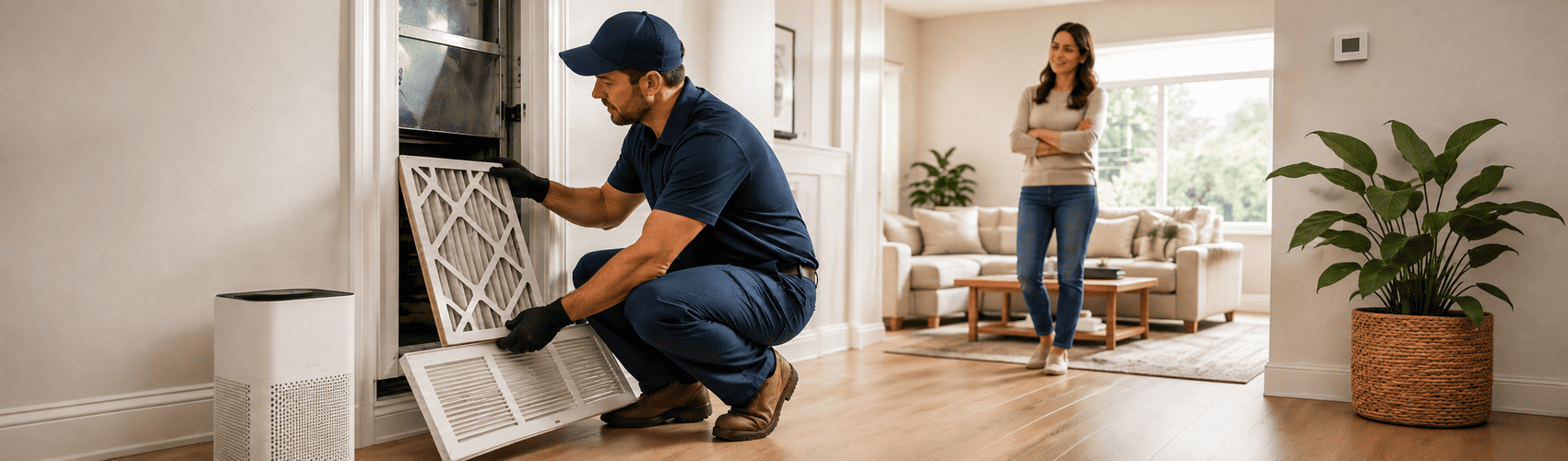
Global Cooling & Plumbing+ provides professional solutions for indoor air quality in Boerne, TX. Our HVAC technicians evaluate the conditions affecting your home and recommend practical options for dust, seasonal pollen, pet dander, odors, excess humidity, stale air, smoke particles, and contaminants entering through the HVAC system.
Depending on the source of the problem, your solution may include whole-home air filtration, air purification, UV air treatment, humidity control, air duct cleaning, duct sealing, ventilation improvements, or HVAC maintenance.
Global Cooling & Plumbing+ serves Boerne from its location at 10008 Johns Rd., Boerne, TX 78006 and can be reached at 830-992-7887.
Call 830-992-7887 to schedule an indoor air quality evaluation in Boerne.
What Is Indoor Air Quality?
Indoor air quality refers to the condition of the air inside a home or building. It is affected by airborne particles, humidity, ventilation, odors, household activities, outdoor air, ductwork, and the condition of the HVAC system.
Common indoor air concerns include:
- Household dust
- Cedar and seasonal pollen
- Pet dander
- Smoke particles
- Musty odors
- Excess humidity
- Construction debris
- Stale air
- Contaminants entering through duct leaks
- Particles recirculating through the HVAC system
Improving indoor air quality usually begins by identifying the source of the concern. No single product addresses every type of indoor contaminant, so the most effective solution may combine filtration, source control, humidity management, ventilation, duct service, and regular HVAC maintenance.
Indoor Air Quality Solutions for Boerne Homes
Boerne homes may be affected by seasonal pollen, Hill Country dust, outdoor smoke, high temperatures, humidity, pet-related particles, and debris entering through air leaks.
Once these contaminants enter the home, the HVAC system may distribute them through connected rooms. Dirty filters, leaky ductwork, inadequate ventilation, moisture problems, and poorly maintained equipment can make indoor air concerns more noticeable.
Our indoor air quality services may include:
- Indoor air quality evaluations
- Whole-home air filtration
- Media air cleaner installation
- Whole-home air purifier installation
- UV air treatment systems
- Dehumidifier installation
- Humidifier installation
- HVAC filter upgrades
- Air duct cleaning
- Air duct sealing
- Ventilation improvements
- HVAC maintenance
The Google results for indoor air quality services in Boerne emphasize cedar pollen, dust, humidity, mold-supporting conditions, air quality testing, duct cleaning, duct sealing, UV treatment, filtration, and whole-home purification.
Signs of Poor Indoor Air Quality
Indoor air quality problems are not always visible. Some homeowners notice recurring dust or odors, while others notice that the air feels humid, stale, or uncomfortable.
Consider scheduling an indoor air quality evaluation when you notice:
- Dust returning soon after cleaning
- Visible buildup around supply or return vents
- Musty, stale, or unexplained odors
- Excess indoor humidity
- Condensation on windows or vents
- HVAC filters becoming dirty quickly
- Pet odors that remain indoors
- Smoke or outdoor odors entering the home
- Stuffy indoor air
- Uneven airflow between rooms
- Debris coming from supply vents
- Moisture near the air handler or ductwork
- Odors when the HVAC system starts
- Increased discomfort during pollen season
- Persistent dust following remodeling work
These signs can have several causes. The underlying issue may involve filtration, humidity, duct leakage, ventilation, equipment cleanliness, airflow, or an indoor contaminant source.
A professional evaluation helps determine which part of the home or HVAC system should be addressed.
Common Indoor Air Quality Concerns in Boerne
| Indoor air concern | Possible sources | Potential solutions |
| Dust | Outdoor air, textiles, household activity, duct leakage | Filter upgrades, duct inspection, duct sealing |
| Cedar and seasonal pollen | Doors, windows, clothing, pets, air leaks | Whole-home filtration, proper filter fit |
| Pet dander | Cats, dogs, and other animals | Filtration, HVAC maintenance, regular cleaning |
| Excess humidity | Outdoor air, HVAC performance, ventilation, moisture intrusion | Dehumidification, HVAC evaluation |
| Musty odors | Moisture, dirty equipment, duct conditions | Moisture control, cleaning, system inspection |
| Smoke particles | Outdoor smoke, cooking, candles, fireplaces | Filtration, purification, ventilation review |
| Construction debris | Remodeling, drywall dust, new construction | Filter replacement, duct inspection or cleaning |
| Stale air | Limited ventilation or weak airflow | Ventilation and HVAC evaluation |
| Uneven airflow | Duct leaks, restrictions, equipment problems | Duct inspection, sealing, airflow correction |
The appropriate solution depends on the source, severity, HVAC configuration, and conditions inside the property.
Whole-Home Air Filtration
Whole-home air filtration treats air as it moves through the central heating and cooling system. Unlike a portable filter designed for one room, a whole-home filter can capture particles before conditioned air is distributed through connected spaces.
A properly selected HVAC filter may help capture:
- Dust
- Pollen
- Pet dander
- Hair
- Fibers
- Household debris
- Some fine airborne particles
Filter performance depends on:
- Filter efficiency
- Filter dimensions
- Proper installation
- Filter fit
- HVAC airflow
- Replacement frequency
- System design
- Household conditions
A more restrictive filter is not automatically better. A filter that creates excessive airflow resistance can affect HVAC performance.
Our technicians evaluate the equipment and airflow requirements before recommending a filtration upgrade.
Media Air Cleaner Installation
A media air cleaner uses a deeper filter cabinet than many standard one-inch HVAC filters.
Its larger filter surface area can provide improved particle capture while maintaining appropriate airflow when correctly selected and installed.
Media air cleaner replacement intervals depend on factors such as:
- Filter specifications
- Household size
- Pets
- Dust levels
- Seasonal pollen
- HVAC use
- Remodeling activity
- Outdoor air conditions
Our technicians can determine whether the existing HVAC system has enough space and airflow capacity for a compatible media air cleaner.
Whole-Home Air Purifier Installation
A whole-home air purifier works with the central HVAC system to treat air circulating through connected rooms.
Purifiers use different technologies and may be designed to address different indoor air concerns. Before recommending a system, we consider:
- The primary air quality concern
- HVAC system compatibility
- Available installation space
- Airflow requirements
- Equipment location
- Maintenance requirements
- Replacement components
- Manufacturer specifications
A whole-home purifier should be part of a broader indoor air quality strategy that may also include filtration, source control, humidity management, duct service, ventilation, and HVAC maintenance.
Global Cooling & Plumbing+ currently promotes whole-home air purification as one of its available services.
UV Air Treatment Systems
UV air treatment systems use ultraviolet light inside the air handler or duct system. They are commonly positioned near the indoor coil or another suitable location within the HVAC equipment.
Depending on the system design, UV treatment may be used to treat exposed HVAC surfaces or air moving through the installation area.
Professional installation helps ensure that the system is:
- Correctly positioned
- Compatible with the HVAC equipment
- Connected to electrical power safely
- Protected from direct occupant exposure
- Accessible for future maintenance
- Installed according to manufacturer specifications
UV systems do not physically capture dust, pollen, pet dander, or other particles. They are generally used alongside effective filtration rather than as a replacement for an HVAC filter.
Whole-Home Humidity Control
Indoor humidity affects comfort and air quality.
Excess humidity can contribute to:
- Musty odors
- Condensation
- Damp indoor conditions
- Moisture near HVAC equipment
- Discomfort
- Conditions that may support unwanted biological growth
A whole-home dehumidifier removes moisture from air and works with the HVAC system to provide broader humidity control than a portable unit serving one room.
Dehumidification may be considered when:
- Indoor air frequently feels humid
- Musty odors persist
- Windows develop condensation
- Certain rooms feel damp
- The air conditioner does not adequately control humidity
- Moisture is present near HVAC components
- Humidity remains elevated during mild weather
Some properties may experience overly dry indoor air during certain conditions. A whole-home humidifier adds controlled moisture as air moves through the HVAC system.
Humidity-control equipment must be correctly sized and adjusted. The right option depends on the property size, HVAC configuration, moisture conditions, available drainage, and installation space.
Air Duct Cleaning in Boerne
Dust, pet hair, construction material, and other debris may collect inside ductwork over time.
Professional air duct cleaning may be appropriate when:
- Visible debris is present inside accessible ducts
- Dust is being released from supply vents
- Remodeling debris has entered the duct system
- Pests have affected the ductwork
- Contamination is visible
- A professional inspection identifies significant buildup
Duct cleaning should be based on the actual condition of the system. It is not a substitute for replacing filters, correcting moisture problems, repairing duct leaks, or maintaining HVAC equipment.
Global Cooling & Plumbing+ provides air duct cleaning in Boerne and nearby Hill Country communities.
Air Duct Sealing
Leaks in ductwork can allow air to enter or escape before it reaches the intended rooms.
Leaky return ducts may draw dust, insulation fibers, humid air, and other contaminants from attics, garages, wall cavities, or unconditioned spaces.
Duct leakage may contribute to:
- Dust entering the HVAC system
- Uneven room temperatures
- Weak airflow
- Longer heating or cooling cycles
- Increased energy use
- Reduced indoor comfort
- Humid air entering from unconditioned areas
Duct sealing addresses accessible gaps, loose connections, and damaged sections using materials intended for HVAC duct systems.
An inspection can help determine whether duct leakage is contributing to indoor air quality, airflow, or comfort concerns.
Ventilation Improvements
Ventilation introduces outdoor air and removes stale indoor air. However, outdoor air in Boerne may contain pollen, dust, heat, humidity, or smoke.
Ventilation should therefore be controlled rather than introduced through uncontrolled gaps and leaks.
Depending on the property, ventilation improvements may include:
- Inspecting existing fresh-air connections
- Evaluating bathroom and kitchen exhaust fans
- Correcting blocked vents
- Reviewing return-air pathways
- Addressing pressure imbalances
- Improving air distribution
- Installing compatible ventilation equipment
The appropriate approach depends on the home’s design, existing HVAC system, occupancy, and outdoor conditions.
HVAC Maintenance and Indoor Air Quality
Routine HVAC maintenance supports indoor air quality by helping the system remain clean, manage moisture, and circulate air as designed.
A maintenance visit may include checking:
- HVAC filters
- Indoor coils
- Blower components
- Condensate drains
- Airflow
- Duct connections
- Equipment cleanliness
- Humidity conditions
- Existing air quality equipment
Maintenance cannot eliminate every indoor contaminant, but it can address system conditions that contribute to dust, odors, humidity, or weak airflow.
How Our Indoor Air Quality Process Works?
1. We Discuss Your Concerns
We begin by asking what you have noticed inside the home.
Common concerns include:
- Recurring dust
- Musty odors
- Excess humidity
- Stale air
- Filter buildup
- Pet-related particles
- Seasonal pollen
- Smoke
- Visible duct debris
- Uneven airflow
2. We Inspect the HVAC System
Our technician inspects accessible components that may affect indoor air quality, including:
- HVAC filter
- Filter cabinet
- Supply and return vents
- Air handler
- Indoor coil area
- Accessible ductwork
- Condensate drainage
- Existing humidity controls
- Existing air treatment equipment
3. We Evaluate Filtration, Humidity, Airflow, and Ductwork
We review the filter type and fit, indoor humidity, airflow conditions, duct connections, visible debris, equipment cleanliness, and possible contaminant sources.
4. We Recommend the Appropriate Solution
The recommendation may include one service or a combination of:
- Filter replacement or upgrade
- Media air cleaner installation
- Whole-home air purification
- UV air treatment
- Humidity control
- Air duct cleaning
- Duct sealing
- Ventilation improvements
- HVAC maintenance
5. We Install, Test, and Explain the System
When new equipment is installed, we complete the required mounting, duct modifications, electrical connections, controls, and performance testing.
We also explain how the system works, what maintenance it requires, and when filters, lamps, or other components may need replacement.
How Much Do Indoor Air Quality Services Cost in Boerne?
The cost of indoor air quality services in Boerne depends on the concern, HVAC system, selected equipment, and installation requirements.
Pricing factors may include:
- Type of service
- HVAC system size
- Number of HVAC systems
- Equipment compatibility
- Filter or purifier type
- Ductwork configuration
- Installation access
- Electrical requirements
- Humidifier or dehumidifier capacity
- UV system design
- Duct cleaning scope
- Required duct repairs or sealing
A basic HVAC filter upgrade usually involves less work than installing a whole-home purifier, dehumidifier, UV system, or ventilation solution.
An on-site evaluation allows our technicians to identify the conditions affecting the property and provide recommendations based on the actual scope of work.
Air Filter vs. Air Purifier
An HVAC filter and a whole-home air purifier both support indoor air quality, but they perform different functions.
| Feature | HVAC air filter | Whole-home air purifier |
| Primary function | Captures particles from circulating air | Treats air using a specific technology |
| Typical location | Return area or filter cabinet | Inside or near HVAC equipment |
| Common targets | Dust, pollen, fibers, pet dander | Varies by purifier technology |
| Maintenance | Periodic filter replacement | Filter, lamp, cell, or component service |
| Works with central HVAC | Yes | Yes |
| Professional installation | Not always | Usually |
An HVAC filter physically captures particles as air passes through it. An air purifier uses an additional treatment method that varies by product.
Many homes benefit from effective filtration before additional air treatment equipment is added.
Portable Air Purifier vs. Whole-Home Air Purifier
A portable air purifier treats air in one room or a limited area. A whole-home purifier treats air moving through the central HVAC system.
| Feature | Portable air purifier | Whole-home air purifier |
| Coverage | One room or limited area | Connected rooms served by the HVAC system |
| Installation | Plug-in placement | Integrated HVAC installation |
| Air movement | Built-in portable fan | Central HVAC airflow |
| Maintenance | Unit-specific filters | System-specific components |
| Best suited for | Targeted room treatment | Broader central air treatment |
The right option depends on the size of the area, the contaminant of concern, HVAC configuration, airflow, and maintenance requirements.
How Can You Check Indoor Air Quality?
Homeowners can begin by checking:
- The condition of the HVAC filter
- Dust around vents
- Indoor humidity
- Musty odors
- Condensation
- Airflow between rooms
- Visible debris inside accessible ducts
- Moisture near HVAC equipment
- Odors when the system starts
- How quickly filters become dirty
A professional HVAC evaluation can help determine whether the concern involves filtration, humidity, duct leakage, ventilation, airflow, or equipment cleanliness.
Specialized environmental or laboratory testing may be necessary when a specific contaminant cannot be identified through an HVAC inspection.
What Is the Best Way to Improve Indoor Air Quality?
The best way to improve indoor air quality is to identify the pollutant or condition first and then address its source.
An effective plan may combine:
- Source control to reduce contaminants entering the home.
- Filtration to capture particles moving through the HVAC system.
- Humidity control to address excess or insufficient moisture.
- Ventilation to remove stale air and manage fresh-air intake.
- Duct service to correct leakage or significant debris.
- HVAC maintenance to keep equipment clean and operating properly.
- Air treatment equipment when an additional purification method is appropriate.
The correct combination depends on the home, HVAC system, and specific indoor air concern.
Why Choose Global Cooling & Plumbing+?
Global Cooling & Plumbing+ provides HVAC, plumbing, and electrical services for Boerne and surrounding Texas Hill Country communities. The company lists Boerne among its service areas, operates a local location at 10008 Johns Rd., Boerne, TX 78006, and publishes HVAC license TACLB161030E.
Customers choose our team for:
- Professional HVAC service
- Indoor air quality evaluations
- Recommendations based on the likely source
- Whole-home filtration options
- Air purifier installation
- UV air treatment solutions
- Humidity-control systems
- Air duct cleaning and sealing
- Ventilation evaluations
- HVAC maintenance
- Clear explanations from technicians
- Local service in the Boerne area
Our goal is to recommend an indoor air quality solution that is compatible with your HVAC system and appropriate for the conditions inside your property.
Schedule Indoor Air Quality Service in Boerne, TX
Dust, pollen, humidity, odors, duct leakage, ventilation, and HVAC conditions can all affect the air inside your home.
Global Cooling & Plumbing+ provides:
- Indoor air quality evaluations
- Whole-home air filtration
- Media air cleaner installation
- Whole-home air purifier installation
- UV air treatment systems
- Humidifier and dehumidifier installation
- Air duct cleaning
- Air duct sealing
- HVAC filter upgrades
- Ventilation improvements
- HVAC maintenance
Call Global Cooling & Plumbing+ at 830-992-7887 to schedule professional service for indoor air quality in Boerne, TX.
Frequently Asked Questions About Indoor Air Quality
What is indoor air quality?
Indoor air quality is the condition of the air inside a home or building. It is affected by airborne particles, humidity, ventilation, odors, outdoor air, household activities, ductwork, and HVAC system conditions.
What are the signs of poor indoor air quality?
Possible signs include recurring dust, musty odors, stuffy air, excess humidity, condensation, rapid filter buildup, visible debris around vents, and unusual odors when the HVAC system operates.
What causes poor indoor air quality in Boerne homes?
Common causes may include cedar and seasonal pollen, household dust, pet dander, outdoor smoke, excess humidity, dirty HVAC filters, duct leakage, inadequate ventilation, construction debris, and moisture near HVAC equipment.
How can I check the indoor air quality in my home?
Begin by checking the HVAC filter, indoor humidity, vents, airflow, visible duct conditions, condensation, and moisture near the heating and cooling system. A professional evaluation can help identify likely causes and determine whether specialized testing is needed.
What is the best way to improve indoor air quality?
The best solution depends on the source of the problem. Improvements may include source control, better HVAC filtration, air purification, humidity control, duct sealing, duct cleaning, ventilation changes, and regular HVAC maintenance.
Do air purifiers remove dust and pollen?
Some air purification and filtration systems can reduce airborne dust and pollen. Performance depends on the technology, filter efficiency, system airflow, equipment sizing, installation, and maintenance.
Does an HVAC UV light improve indoor air quality?
An HVAC UV system treats exposed surfaces or air moving through the installation area, depending on the equipment design. UV lights do not capture dust or pollen and are generally combined with effective filtration.
Can high humidity affect indoor air quality?
Yes. High indoor humidity can contribute to discomfort, condensation, musty odors, and moisture-related concerns. HVAC service or whole-home dehumidification may help when humidity remains elevated.
Does air duct cleaning improve indoor air quality?
Air duct cleaning may help when ducts contain visible debris, construction material, pest contamination, or significant buildup. It should be combined with proper filtration, moisture control, HVAC maintenance, and duct repair when necessary.
Can duct leaks affect indoor air quality?
Yes. Leaky return ducts may draw dust, insulation fibers, humid air, and other contaminants from attics, garages, wall cavities, or unconditioned spaces. Duct inspection and sealing may help correct these problems.