
 SCHEDULE A SERVICE

Content:
- 1 Step 1: Load calculation (Manual J)
- 2 Step 2: System selection and equipment specification
- 3 Step 3: Ductwork inspection and remediation
- 4 Step 4: Equipment installation and commissioning
- 5 Step 5: Performance verification and homeowner walkthrough
- 6 Wrong system size
- 7 Skipping or ignoring ductwork problems
- 8 Improper refrigerant charging
- 9 Poor outdoor unit placement
- 10 No documentation provided
- 11 How long does air conditioner installation take?
- 12 What should I expect during AC installation day?
- 13 What are the most common AC installation mistakes?
- 14 What questions should I ask before AC installation?
- 15 How do I know if my new system was installed correctly?
- 16 Does air conditioner installation affect my warranty?
- 17 How much does air conditioner installation cost in the Hill Country?
- 18 Do I need to replace my ductwork when I install a new AC?
Global Cooling & Plumbing+ | Licensed HVAC Technicians | Upfront Pricing | 10% Off for Veterans & Seniors 📞 (830) 992-7887 | office@globalcoolingtx.com | globalcoolingtx.com
Replacing or installing a new cooling system is one of the largest home improvement decisions a Hill Country homeowner will make. A correctly sized and properly installed system will run efficiently for 15–20 years, keep energy bills predictable, and hold up through decades of Texas summers. A poorly installed one — regardless of the brand or price — can underperform from day one, void manufacturer warranties, and generate repair costs that accumulate far beyond what a better installation would have cost.
This guide covers everything you need to know about air conditioner installation in Boerne, Kerrville, and Fredericksburg: what the process involves, what the air conditioning installation steps look like from start to finish, which AC installation mistakes are most costly, and the questions to ask before AC installation to make sure you’re hiring the right contractor.
What Every Hill Country Homeowner Should Know Before Installing
- Air conditioner installation in Texas requires proper load calculation — the same unit that works in a Dallas suburb will be wrong-sized for a Hill Country home with different sun exposure, ceiling heights, and construction.
- The air conditioning installation steps your contractor follows directly determine how efficiently your system runs — and whether your manufacturer warranty stays valid.
- Most AC installation mistakes happen during sizing and ductwork assessment, not during the physical installation itself.
- Knowing the right questions to ask before AC installation is the single most effective way to separate qualified contractors from those who will cut corners.
- Two professional visits per year are typically required to maintain warranty coverage after installation is complete.
What Is Air Conditioner Installation?
Air conditioner installation is the professional process of selecting, sizing, and installing a cooling system — including the indoor air handler, outdoor condenser unit, refrigerant lines, electrical connections, and ductwork integration — so that the system operates at its rated efficiency and capacity.
Done correctly, air conditioner installation is a structured, full-day process that begins with a load calculation and ends with verified system performance. Done incorrectly, it’s one of the most expensive mistakes a homeowner can make — because the consequences often don’t show up as a single catastrophic failure. They show up as slightly higher energy bills every month, a system that runs longer than it should, and components that wear out two or three years earlier than they would have otherwise.
In the Texas Hill Country, air conditioner installation carries additional complexity. Homes here often have irregular shapes, vaulted ceilings, significant west-facing sun exposure, and ductwork that was sized for older, less efficient equipment. A contractor who doesn’t account for those factors during sizing and planning will install a system that technically works — just never as well as it should.
What to Expect During AC Installation
Understanding what to expect during AC installation helps you evaluate whether your contractor is following a thorough process or rushing through it to move to the next job.
Most residential air conditioner installation jobs in the Hill Country take between six and ten hours. Larger homes, complex duct configurations, or systems that require panel upgrades may take longer. Here is what a proper installation day looks like:
Morning — site preparation and removal. The technician team arrives, reviews the installation plan with you, and removes the existing equipment if this is a replacement. The indoor and outdoor spaces are cleared and protected. If ductwork needs modification, this work begins before the new equipment is set.
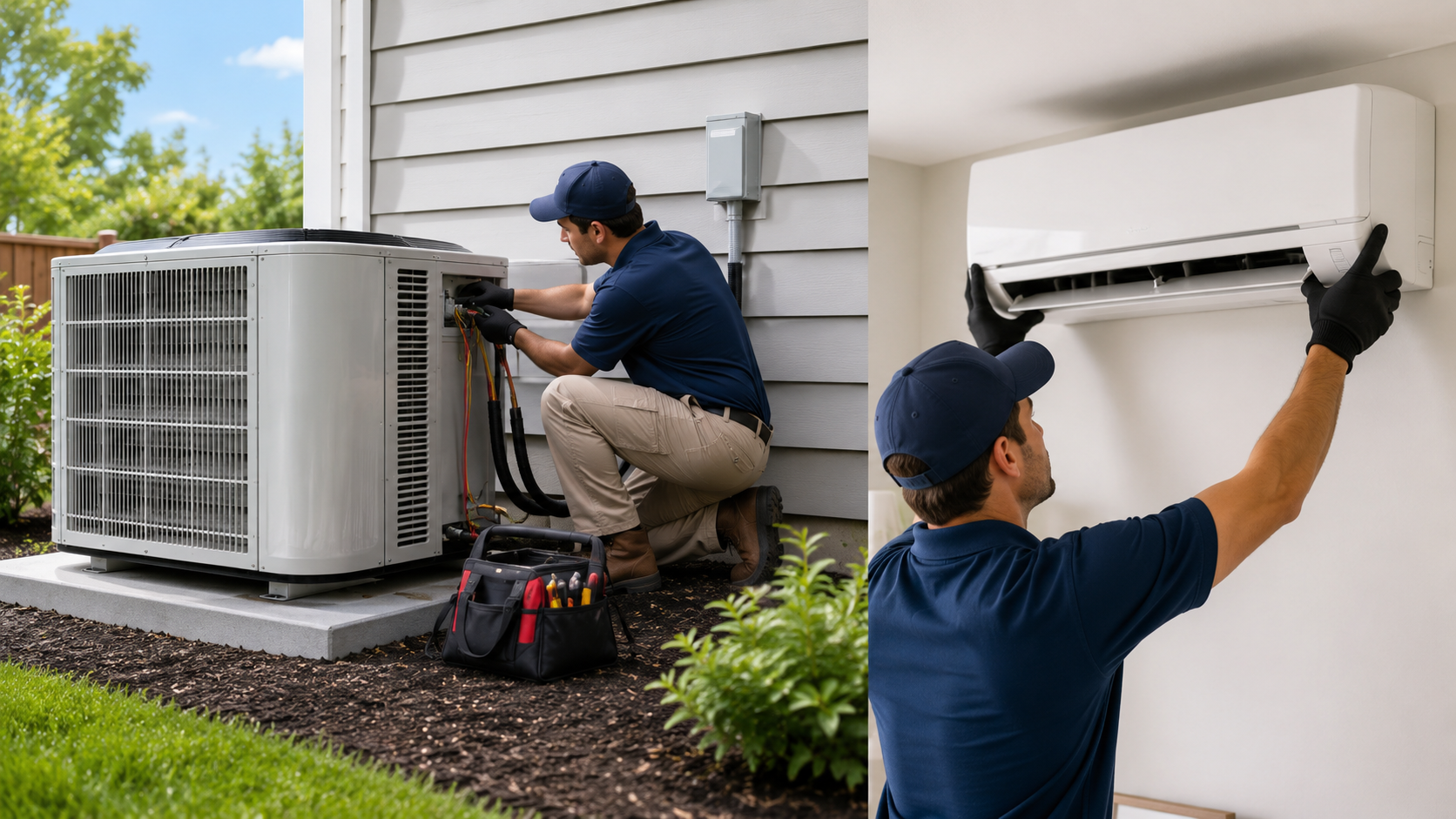
Mid-morning — equipment positioning. The indoor air handler is installed in the mechanical space, properly leveled and secured. The outdoor condenser is placed on a new pad or existing surface, leveled, and positioned with adequate clearance on all sides for airflow. Placement matters more than most homeowners realize — a condenser crammed against a wall or under a low overhang will run hotter and work harder than one with proper clearance.
Midday — connections. Refrigerant lines are run between the indoor and outdoor units, properly insulated and secured. Electrical connections are made at both units and at the disconnect box. The condensate drain line is connected and routed to an appropriate drain point.
Afternoon — system commissioning. This is the step that separates a thorough air conditioner installation from a rushed one. The system is vacuumed down to remove moisture and non-condensables from the refrigerant circuit before charging. Refrigerant is charged to the manufacturer’s specified level — not estimated, not approximated. Airflow is measured and balanced across zones. The thermostat is configured and tested. A final temperature differential check confirms the system is producing the correct delta between supply and return air.
Knowing what to expect during AC installation means you can ask your contractor where they are in this process and whether each step is being completed — or skipped.
Air Conditioning Installation Steps: What a Professional Process Looks Like
The air conditioning installation steps your contractor follows determine the long-term performance of your system more than the brand of equipment does. Here is what each step involves and why it matters.
Step 1: Load calculation (Manual J)
Before any equipment is selected, a qualified contractor performs a Manual J load calculation — a room-by-room assessment of your home’s heat gain and heat loss based on square footage, insulation values, window area and orientation, ceiling height, local climate data, and occupancy patterns.
This is the most important of all air conditioning installation steps, and it’s the one most commonly skipped by contractors who simply replace the old unit with the same size. An oversized system short-cycles — it cools the space quickly but shuts off before adequately removing humidity, leaving you with a cold, clammy home and a compressor that’s starting and stopping dozens of times a day. An undersized system runs continuously and never quite gets ahead of the heat. Neither condition is comfortable, and both accelerate wear on the equipment.
Step 2: System selection and equipment specification
Once the load calculation is complete, your technician recommends the right unit based on your home’s cooling load, your efficiency goals, and your budget. Key specifications include SEER2 rating (the current efficiency standard), refrigerant type, compressor technology, and compatibility with any zoning or smart thermostat systems you have or plan to add.
Step 3: Ductwork inspection and remediation
Ductwork is one of the most overlooked air conditioning installation steps in a replacement project. If your existing ducts are leaking, undersized for the new equipment, or poorly insulated in an unconditioned attic, installing a new high-efficiency unit on top of that infrastructure will cost you 20–30% of your potential efficiency gains before the system runs its first cycle.
A thorough contractor inspects all accessible ductwork, measures static pressure, identifies leaks and restrictions, and recommends repairs before the new equipment goes in. At Global Cooling & Plumbing+, this is a standard part of every air conditioner installation — not an upsell.
Step 4: Equipment installation and commissioning
The physical installation of the indoor and outdoor units, refrigerant lines, electrical connections, and drain lines — followed by the system commissioning process described above. This step should never be rushed. Proper vacuuming and refrigerant charging alone can take an hour and are critical to long-term system performance.
Step 5: Performance verification and homeowner walkthrough
Before the technician leaves, the system should be verified operating within spec — correct airflow, correct temperature differential, correct refrigerant charge. You should receive documentation of the installation, including equipment model and serial numbers, refrigerant charge data, and a service record that satisfies your manufacturer’s AC warranty maintenance requirements. A brief walkthrough of thermostat operation and filter maintenance expectations rounds out a complete installation.
AC Installation Mistakes That Cost Homeowners the Most
Most AC installation mistakes aren’t visible on installation day. They show up over months and years as inefficiency, discomfort, and accelerated equipment failure. These are the ones that matter most.
Wrong system size
Incorrect sizing is the most consequential of all AC installation mistakes, and it happens far more often than it should. As described above, both oversizing and undersizing create real problems — but oversizing is particularly common because some contractors size up as a hedge or simply match the existing tonnage without checking whether the original system was correctly sized in the first place.
If a contractor quotes you a replacement system without performing a Manual J calculation or at minimum asking detailed questions about your home, that’s a sign to look elsewhere.
Skipping or ignoring ductwork problems
Installing a new, efficient air conditioner on a leaking or undersized duct system is one of the most common AC installation mistakes in older homes. The new unit will struggle to deliver conditioned air where it’s needed, run longer than it should, and return efficiency numbers nowhere near its SEER2 rating. Always ask whether ductwork will be inspected before installation is finalized.
Improper refrigerant charging
Refrigerant charge must match the manufacturer’s specification precisely. Undercharged systems lose capacity and efficiency. Overcharged systems run at elevated pressures that stress the compressor. Both conditions shorten equipment life significantly. Proper charging requires a recovered vacuum followed by measured charging — not a quick visual check of gauges.
Poor outdoor unit placement
The condenser needs adequate clearance on all sides — typically 18–24 inches — to exhaust heat effectively. AC installation mistakes around condenser placement include positioning too close to walls or fencing, under overhangs that restrict vertical airflow, or in locations that receive significant heat radiation from paved surfaces. A condenser in a poor location works harder, runs hotter, and wears out faster.
No documentation provided
After installation is complete, you should receive written documentation of the work performed — equipment specs, refrigerant charge data, and a signed service record. Without this, you may have difficulty meeting AC warranty maintenance requirements if a claim is needed later. Always ask for documentation before the technician leaves.
Questions to Ask Before AC Installation
Having the right questions to ask before AC installation prepared before you speak with a contractor will tell you more about their competence and integrity than any online review. These are the most important ones.
Will you perform a Manual J load calculation? This is the fundamental questions to ask before AC installation. Any contractor who says it isn’t necessary, or who sizes the replacement unit based solely on what was there before, is telling you something important about how they work.
What SEER2 rating do you recommend, and why? A qualified contractor should be able to explain the trade-off between upfront cost and long-term energy savings for your specific usage patterns — not just recommend the cheapest available unit.
Will you inspect the ductwork before installation? If ductwork issues are discovered, you want to know about them before the new equipment goes in, not after.
What does the commissioning process include? Specifically: do they vacuum the system before charging, and how do they verify the refrigerant charge? These are questions to ask before AC installation that will quickly reveal whether you’re dealing with a thorough contractor or one who moves fast and moves on.
What warranties are included, and what are the maintenance requirements? Equipment warranties typically require annual professional maintenance documentation. Ask what’s required and whether the contractor offers a maintenance plan that satisfies those terms.
What will the installation day look like? A contractor who can walk you through the full day’s process clearly — including commissioning steps — is more likely to actually follow it.
Central AC vs Ductless Mini-Split: Which Is Right for Your Home?
| Feature | Central AC | Ductless mini-split |
| Best for | Whole-home cooling via existing ducts | Additions, rooms without ducts, or zoned cooling |
| Installation complexity | Higher — ductwork required | Lower — no ducts needed |
| Energy efficiency | Good (up to 20 SEER2) | Very high (up to 30+ SEER2) |
| Upfront cost | Moderate to high | Moderate to high |
| Zoning capability | Limited without add-ons | Excellent — each head is independent |
| Aesthetic impact | Minimal (vents in ceiling/floor) | Wall-mounted indoor heads visible |
For most Hill Country homes with existing ductwork in reasonable condition, central air conditioner installation remains the most practical choice. For room additions, detached structures, or homes with duct systems that would require significant remediation, a ductless mini-split is often the better investment.
After Installation: Protecting Your Investment
Once your air conditioner installation is complete, a few straightforward habits will protect the system’s performance and keep your warranty intact.
Replace filters every one to three months depending on filter type and household dust levels. A clogged filter is the single most preventable cause of reduced airflow and coil icing, and it’s entirely within your control between service visits.
Schedule professional maintenance twice per year — spring before the cooling season begins, and fall after heavy summer use. Most manufacturers require documented annual maintenance to honor warranty claims; twice-yearly visits give you more protection and catch developing issues earlier. Keep every service invoice — model number, serial number, work performed, and technician signature — in a dedicated folder or email thread.
Monitor your system’s behavior through summer. Rising energy bills without a change in usage, rooms that aren’t reaching temperature, or unusual sounds are all early signals worth a service call before they become more serious problems.
Frequently Asked Questions — Air Conditioner Installation in the Hill Country
How long does air conditioner installation take?
Most residential air conditioner installation jobs in the Hill Country take six to ten hours. Homes with more complex ductwork, panel upgrades, or multi-zone systems may require two days. Your technician should give you a realistic time estimate before the installation date.
What should I expect during AC installation day?
Expect the team to arrive with the equipment already staged, walk you through the plan, remove existing equipment, install both indoor and outdoor units, run refrigerant and electrical connections, vacuum and charge the system, test airflow and performance, and provide documentation before leaving. The commissioning and testing phase at the end is what separates a thorough installation from a rushed one.
What are the most common AC installation mistakes?
The most costly AC installation mistakes are incorrect system sizing, skipping ductwork inspection, improper refrigerant charging, poor condenser placement, and failing to provide documentation at the end of the job. All of these are preventable with the right contractor and the right questions asked upfront.
What questions should I ask before AC installation?
The most important questions to ask before AC installation are: Will you perform a Manual J load calculation? Will you inspect the ductwork? What does your commissioning process include? What warranties apply, and what maintenance is required to keep them valid?
How do I know if my new system was installed correctly?
A correctly completed air conditioner installation should include documented refrigerant charge data, verified airflow measurements, a functioning thermostat calibration, and a written service record. If your installer leaves without providing documentation or performing a commissioning check, ask for it before signing off.
Does air conditioner installation affect my warranty?
Yes. Manufacturer warranties on HVAC equipment typically require professional installation by a licensed technician and documented annual maintenance visits. Poor installation — specifically incorrect refrigerant charging or improper electrical connections — can void warranties before the first service visit.
How much does air conditioner installation cost in the Hill Country?
Residential air conditioner installation in Boerne, Kerrville, and Fredericksburg typically ranges from $4,500 to $9,500 depending on system size, efficiency rating, ductwork condition, and any necessary electrical upgrades. Call (830) 992-7887 for an upfront quote specific to your home.
Do I need to replace my ductwork when I install a new AC?
Not always — but your ductwork should always be inspected before a new system goes in. If existing ducts are leaking, undersized, or poorly insulated, addressing those issues as part of the air conditioner installation project will protect your efficiency gains and prevent the new system from being held back by aging infrastructure.
Schedule Your Air Conditioner Installation in Boerne, Kerrville & Fredericksburg
A high-quality air conditioner installation is the foundation of long-term comfort, efficiency, and reliability in a Texas Hill Country home. Understanding the air conditioning installation steps your contractor should follow, the AC installation mistakes that most commonly lead to poor outcomes, and the questions to ask before AC installation gives you the tools to make a confident decision — and hold your contractor to a high standard.
If you’re ready to move forward, or just want an honest assessment of your current system and what replacement would look like, our licensed HVAC technicians are ready to help.
Global Cooling & Plumbing+ Licensed HVAC Technicians | Upfront Pricing | 10% Off for Veterans & Seniors
📞 (830) 992-7887 ✉️ office@globalcoolingtx.com 🌐 globalcoolingtx.com
Serving Boerne, Kerrville, Fredericksburg, and the Texas Hill Country.