
 SCHEDULE A SERVICE

Content:
- 1 Key Takeaways: Proper AC Installation in the Texas Hill Country
- 1.1 What is proper AC installation?
- 1.2 What is a Manual J AC load calculation?
- 1.3 How does ductwork affect AC performance?
- 1.4 Does insulation affect how well my AC works?
- 1.5 How do I know if my system was installed correctly?
- 1.6 How long does proper AC installation take?
- 1.7 Does proper AC installation affect my warranty?
- 1.8 Why do Hill Country homes need special attention during AC installation?
Global Cooling & Plumbing+ | Licensed HVAC Technicians | Upfront Pricing | 10% Off for Veterans & Seniors 📞 (830) 992-7887 | office@globalcoolingtx.com | globalcoolingtx.com
Most homeowners focus on the equipment when replacing or installing a new cooling system — the brand, the efficiency rating, the price. What actually determines how well the system performs, how long it lasts, and how much it costs to run every month is something that happens before and during the installation itself: the quality of the process.
Proper AC installation is the foundation everything else rests on. A high-efficiency unit installed incorrectly will underperform a mid-range unit installed correctly. In the Texas Hill Country — where summer heat is extreme, homes vary dramatically in age and construction, and cooling seasons run longer than almost anywhere else in the country, the margin for error is even smaller than it is elsewhere.
This guide covers the three technical pillars of proper AC installation: AC load calculation, ductwork design for AC installation, and insulation and AC efficiency and explains what each one involves, why it matters, and how to verify your contractor is taking it seriously.
Key Takeaways: Proper AC Installation in the Texas Hill Country
- Proper AC installation determines system performance — even the most expensive unit will fail to deliver comfort or efficiency if it’s installed incorrectly.
- AC load calculation is the foundation — accurate sizing prevents short cycling, reduces wear, and ensures your system can handle extreme Texas heat.
- Ductwork design for AC installation directly affects airflow — poorly designed or leaking ducts can reduce efficiency by up to 30% and create uneven cooling.
- Insulation and AC efficiency go hand in hand — without proper insulation, your system will work harder, run longer, and increase energy costs.
- Most installation problems start before installation day — planning, sizing, and system design are where the biggest mistakes happen.
- Professional calibration is not optional — correct refrigerant charge, airflow balancing, and thermostat setup are critical for long-term performance.
- A complete installation includes verification and documentation — this protects your warranty and ensures your system is operating within manufacturer specifications.
What Every Hill Country Homeowner Should Know
- Proper AC installation begins with a precise AC load calculation — not an estimate, not a match to the previous unit’s tonnage.
- Ductwork design for AC installation determines how much of your system’s rated efficiency actually reaches your living spaces.
- Insulation and AC efficiency are directly linked: a system installed in an under-insulated home will never perform to spec, regardless of brand or SEER2 rating.
- Most manufacturer warranties require documented professional installation and annual maintenance — cutting corners on either can leave you unprotected.
- Homes in Fredericksburg, Kerrville, and Boerne face specific challenges — sun exposure, vaulted ceilings, older duct systems — that make a methodical installation approach more important, not less.
What Is Proper AC Installation?
Proper AC installation is the complete process of sizing, configuring, and installing a residential air conditioning system so that it operates at its designed efficiency, delivers consistent airflow to all areas of the home, and meets the manufacturer’s specifications for refrigerant charge, electrical connection, and system calibration.
It is not simply placing equipment and connecting it. Proper AC installation encompasses the decisions made before a single component is moved — what size system the home actually needs, whether the existing ductwork can support it, and whether the building envelope is capable of holding the conditioned air the system produces.
When any one of those elements is handled carelessly, the entire system pays the price. An oversized unit short-cycles and fails to control humidity. An undersized one runs constantly and wears out early. A system installed on leaking ductwork loses a significant share of its output before it reaches the rooms it’s meant to cool. A system in a poorly insulated home fights a losing battle against heat gain no matter how efficiently the equipment itself operates.
Proper AC installation in the Texas Hill Country requires understanding all of these factors as a connected system — not a series of independent boxes to check.
AC Load Calculation: Why Sizing Is the Most Important Decision
The first and most consequential step in proper AC installation is the AC load calculation. This is the engineering process that determines exactly how much cooling capacity your home requires — and it has to be done correctly before any equipment is selected or ordered.
The industry-standard method is called Manual J. A Manual J AC load calculation evaluates your home room by room, taking into account square footage, ceiling height, window area and orientation, glass type, wall and attic insulation values, local climate data, internal heat sources, and the number of occupants. The result is a precise cooling load figure — typically expressed in BTUs per hour — that tells your technician exactly what size system your home needs.
What the AC load calculation is not is a simple square-footage formula or a match to whatever unit was installed before. Those approaches are common, and they’re one of the most frequent sources of long-term HVAC performance problems in Hill Country homes.
Oversized systems — installed because a contractor rounded up “just to be safe” or assumed bigger is better — cool spaces too quickly. The system reaches the thermostat setpoint and shuts off before completing a full cycle, a phenomenon called short-cycling. The problem isn’t just efficiency: short-cycling means the system never runs long enough to pull adequate moisture from the air, leaving the home feeling cold but clammy. It also means the compressor starts and stops far more frequently than it was designed to, accumulating wear that shortens its lifespan significantly.
Undersized systems — installed because someone used a quick estimate rather than a proper AC load calculation — run continuously during peak heat, never quite reaching the setpoint. Energy bills climb, the equipment never gets a rest cycle, and components wear out faster under the sustained load.
A proper Manual J AC load calculation eliminates both of these outcomes. It’s a step that takes time and requires genuine knowledge of your home — which is why some contractors skip it. If a contractor cannot explain how they sized your system or won’t perform a Manual J calculation before recommending equipment, that’s a clear signal about the quality of the installation you’ll receive.
Ductwork Design for AC Installation: The Hidden Performance Factor
Once the correct system size is established, the next pillar of proper AC installation is ductwork design. Ductwork design for AC installation is the process of evaluating, modifying, or designing the air distribution system to ensure that conditioned air reaches every room in the correct volume and at the correct velocity.
This step is particularly important — and particularly easy to get wrong — in replacement projects. When an existing system is replaced, many contractors simply connect the new equipment to the existing ductwork without inspection. That approach assumes the old duct system was correctly designed for the original equipment, is still in good condition, and is compatible with the new unit’s airflow requirements. All three of those assumptions are frequently wrong.
Ductwork design for AC installation involves several specific evaluations:
Duct sizing and static pressure. Each duct run needs to be sized to deliver the correct airflow volume to the room it serves. If duct runs are undersized relative to the new system’s fan capacity, static pressure builds, airflow drops, and the system strains to move air. A proper ductwork design for AC installation includes measuring static pressure at the air handler and comparing it against the equipment’s rated operating range.
Air leakage. Duct systems in Texas attics are subject to significant wear — connections loosen, flexible duct kinks or tears, and mastic sealant degrades over time. Studies consistently show that residential duct systems lose 20–30% of conditioned air to leakage before it reaches the living space. Identifying and sealing those leaks before a new system is installed means the new equipment is working with the benefit of that recovered capacity from day one.
Airflow balance. Ductwork design for AC installation also involves ensuring that each room receives airflow proportional to its cooling load. Rooms with large windows, west-facing walls, or high heat gain need more airflow than smaller interior rooms. A balanced system eliminates hot spots and cold spots — which are almost always a duct distribution problem, not an equipment problem.
Insulation in unconditioned spaces. Duct runs in attics or crawlspaces need to be insulated to prevent heat gain into the supply air before it reaches the registers. In a Texas attic that reaches 140°F on a summer afternoon, uninsulated or under-insulated ductwork can raise supply air temperature by 10°F or more on its way from the air handler to the room.
Ductwork design for AC installation is one of the most overlooked phases of a replacement project, and it’s one of the areas where working with a thorough contractor makes the greatest difference to long-term performance.
Insulation and AC Efficiency: The Building Envelope Connection
The third pillar of proper AC installation is one that goes beyond the HVAC system itself: the relationship between insulation and AC efficiency. A cooling system operates within a building envelope — the walls, ceiling, windows, and floor that separate conditioned air from the outdoor environment. How well that envelope is sealed and insulated directly determines how hard your AC has to work to maintain a comfortable temperature.
The connection between insulation and AC efficiency is straightforward: every degree of heat that enters your home through an under-insulated attic or air-sealed wall is a degree your cooling system has to remove. A system that’s fighting significant heat gain through the building envelope runs longer cycles, uses more energy, and reaches the end of its service life sooner than one installed in a well-sealed home.
In the Texas Hill Country, attic insulation is typically the highest-leverage area. Attic temperatures in Fredericksburg and Kerrville regularly reach 130–150°F on summer afternoons. If attic insulation is below the recommended R-38 to R-60 range for this climate zone, that heat conducts down through the ceiling into living spaces continuously throughout the hottest part of the day — adding to the cooling load your new system has to manage.
Key areas where insulation and AC efficiency interact most directly:
Attic insulation depth and condition. Blown-in insulation settles over time and loses R-value. In older homes, it may have been installed at levels that were considered adequate decades ago but fall short of current standards. A thermal assessment of the attic before AC installation gives you an accurate picture of what your system is working against.
Air sealing at the ceiling plane. Insulation stops conductive heat transfer, but air sealing stops convective transfer — warm air moving through gaps around light fixtures, attic hatches, and penetrations. Both matter, and they work together. Improving air sealing at the ceiling plane before a new system is installed reduces infiltration load significantly.
Wall insulation and window performance. Particularly relevant for west-facing walls in Hill Country homes that take the full force of afternoon sun. Exterior wall insulation and high-performance window glazing reduce peak cooling load on the hottest afternoons — the exact conditions when your system is already working hardest.
Addressing insulation and AC efficiency concerns before installation isn’t always possible or economical in every project. But understanding where your home stands gives you an accurate expectation of how your new system will perform and informs the correct sizing decisions during the AC load calculation phase.
System Calibration and Commissioning
Proper AC installation doesn’t end when the last wire is connected. System commissioning — the process of verifying that the installed equipment operates correctly — is what separates a complete installation from one that simply appears finished.
Commissioning includes evacuating the refrigerant circuit with a vacuum pump to remove moisture and non-condensables before charging, then charging the system to the manufacturer’s specified refrigerant weight. It includes measuring airflow at the supply and return registers, verifying that static pressure is within the operating range, and calibrating the thermostat. It ends with a temperature differential check — confirming that the supply air leaving the registers is 18–22°F cooler than the return air entering the system, the standard indicator of correct refrigerant charge and airflow.
Before the installation is signed off, your technician should provide written documentation: equipment model and serial numbers, refrigerant charge data, static pressure measurements, and a completed service record. This documentation is not just good practice — it’s what most manufacturers require to support warranty claims if a component fails later.
The Proper AC Installation Checklist
Before approving any air conditioner installation, confirm your contractor has addressed each of the following:
AC load calculation — a Manual J calculation performed for your specific home, not a rule-of-thumb size estimate or a match to the previous unit. Ask to see the calculation or at minimum a written explanation of how the system was sized.
Ductwork design for AC installation — existing ductwork inspected for leaks, restrictions, and compatibility with the new equipment. Any identified issues addressed before the new system is commissioned.
Insulation and AC efficiency assessment — attic insulation levels verified and any significant deficiencies noted, so you understand what your system is working against and whether pre-installation improvements are worth considering.
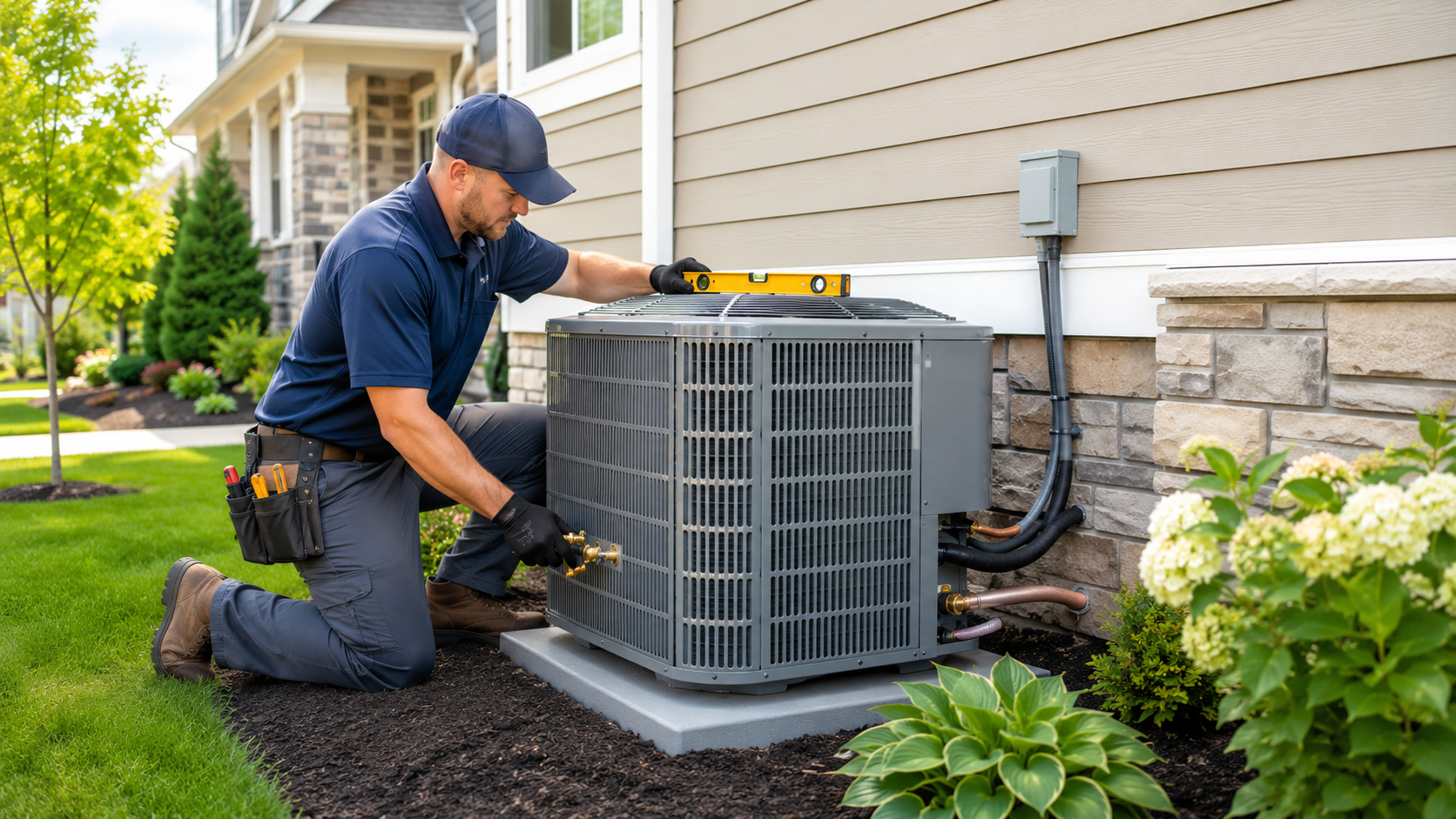
Equipment installation — indoor and outdoor units correctly positioned, leveled, and secured with adequate clearance around the condenser for airflow.
Commissioning — system vacuumed, refrigerant charged to spec, airflow measured, thermostat calibrated, temperature differential verified.
Documentation — written service record provided at completion, including all data required to support manufacturer warranty compliance.
Frequently Asked Questions — Proper AC Installation in the Hill Country
What is proper AC installation?
Proper AC installation is the complete process of correctly sizing a system through AC load calculation, designing or verifying ductwork for adequate airflow distribution, addressing insulation and AC efficiency factors in the building envelope, and commissioning the system to manufacturer specifications before sign-off.
What is a Manual J AC load calculation?
A Manual J AC load calculation is the industry-standard method for determining the correct cooling capacity for a home. It evaluates square footage, ceiling height, insulation levels, window area and orientation, local climate data, and occupancy to produce a precise BTU requirement — the foundation of proper AC installation sizing.
How does ductwork affect AC performance?
Ductwork design for AC installation determines how much of your system’s rated capacity actually reaches the rooms it’s meant to cool. Leaking, undersized, or poorly balanced duct systems can reduce effective efficiency by 20–30%, meaning a high-efficiency unit performs like a standard one because of what’s lost in distribution.
Does insulation affect how well my AC works?
Yes, directly. Insulation and AC efficiency are connected because every degree of heat that enters your home through an under-insulated ceiling or wall is additional cooling load your system has to remove. Improving attic insulation and air sealing before installation reduces the work your new system has to do from day one.
How do I know if my system was installed correctly?
A properly commissioned installation will include documented refrigerant charge data, static pressure measurements, and a verified temperature differential of 18–22°F between supply and return air. If your installer leaves without providing written documentation or performing a commissioning check, ask for it before approving the work.
How long does proper AC installation take?
Most residential installations in the Hill Country take six to ten hours. Projects that require ductwork remediation, electrical panel upgrades, or multi-zone configurations may take longer. A contractor who quotes a two-hour installation for a full system replacement is almost certainly skipping critical steps.
Does proper AC installation affect my warranty?
Yes. Most HVAC manufacturers require professional installation by a licensed technician and documented annual maintenance visits to keep warranties valid. Improper refrigerant charging or electrical connections performed during installation can void coverage before the first service visit.
Why do Hill Country homes need special attention during AC installation?
Homes in Fredericksburg, Kerrville, and Boerne present specific challenges — extreme summer heat, long cooling seasons, significant west-facing sun exposure, vaulted ceilings common in Hill Country architecture, and older duct systems originally designed for less efficient equipment. Proper AC installation in this region requires accounting for all of these factors, not applying a one-size-fits-all approach.
Schedule Your Proper AC Installation Consultation
Getting the installation right from the beginning is far less expensive than correcting the consequences of getting it wrong. If you’re replacing an existing system or installing cooling in a new space, our licensed HVAC technicians will perform a full AC load calculation, assess your ductwork design for AC installation compatibility, and evaluate insulation and AC efficiency factors before recommending any equipment.
Every project comes with upfront pricing before work begins and complete documentation at completion — so you leave with everything you need to protect your warranty and your investment.
Global Cooling & Plumbing+ Licensed HVAC Technicians | Upfront Pricing | 10% Off for Veterans & Seniors
📞 (830) 992-7887 ✉️ office@globalcoolingtx.com 🌐 globalcoolingtx.com
Serving Fredericksburg, Kerrville, Boerne, and the Texas Hill Country.